Powered By Blogger

Friday, November 18, 2011

Ladies on the Lam: SAFE IN HELL and THE LEGEND OF BILLIE JEAN


Put away your bootlegs: it's time for Missing No More!  Two more of The Horn Section's past review subjects are now on DVD for the first time, thanks once again to our good friends at the Warner Archive.   It's almost becoming a monthly occurrence.

While our two cult movies were released fifty-four years apart, they surprisingly have a lot in common.  Both center around a southern girl who is tough as nails: one a Corpus Christi teenager, the other a New Orleans secretary.  Both women suffer injustices at the hands of powerful males and financial hardship afterward.  Both also draw the line at providing physical favors to the men who wronged them.  When each lady defends herself, a felony is the (unintended) result, so both heroines end up running from the law.


That's a lot these two films have in common, despite the features taking place in very disparate eras: SAFE IN HELL (1931) is product of the "anything goes" pre-Code early thirties, while THE LEGEND OF BILLIE JEAN (1985) was produced in the middle of a decidedly conservative decade for Hollywood.  Reflective of their respective periods: the bulk of the former takes place in a literally Godless atmosphere, while BILLIE JEAN's title character is inspired and empowered by SAINT JOAN.  But hey, enough comparisons and contrasts.  Let's get to the good news.


The folks over at the Warner Archive finally agreed that fair is fair and released THE LEGEND OF BILLIE JEAN on November 1st.  Released through the label's Columbia Classics subdivision, it is reasonably priced at $14.96.

BILLIE JEAN's steady march to a loyal following didn't get off to a promising start, as it was an outright disaster at the box office in the summer of 1985 despite considerable promotion from MTV.  BILLIE JEAN was lost in the shuffle at theatres during the summer of BACK TO THE FUTURE.  It finally found its audience the way many initially overlooked movies did in the Eighties, via healthy home video rentals and saturation showings on cable.


THE LEGEND OF BILLIE JEAN did produce one immediate success, from its Chrysalis-heavy soundtrack: Pat Benatar's "Invincible", complete with the music video below featuring a healthy dose of clips from the film.  Ironically, one person who isn't a fan is Pat Benatar, who reportedly to this day derides the film in concert as "the worst ever made" before performing her hit "Invincible", the smash hit from the film's soundtrack. 


If this is true, then lighten up Ms. Benatar!  It's been twenty-five years and you were ten years older than the target audience to begin with.  In my review I noted that BILLIE JEAN has its problems script-wise, but it's also easy to see why this film strikes a chord with many.  It's great to see it not only newly remastered, with including an all-new commentary as well.  Way to go, Warner!

Perhaps even more impressive is the release of SAFE IN HELL (1931), which never saw a home video release of any kind before November 8th, when Warner Archive came through for us pre-Code aficionados and made it available for $19.95.  Here's a few minutes from the film, as leading lady Dorothy Mackaill checks into the Tortuga hotel managed by Nina Mae McKinney:


It's a rare appearance by McKinney, who was only 19 at the time, and features the equally underappreciated stars Dorothy Mackaill and Clarence Muse.  I have to say that in all my years seeking out obscure hidden treasures of cinema, SAFE IN HELL remains one of the most pleasant surprises I've ever stumbled across.

Directed by the great William Wellman (PUBLIC ENEMY, A STAR IS BORN), SAFE IN HELL offers McKinney and Muse non-sterotypical roles, all too rare for African-American actors in the Thirties. Wellman's underrated work is also tough and uncompromising right up to the less than happy denouement which is a surprise, even for pre-Code Hollywood.


If you haven't shopped at the Warner Archive yet, by all means browse the inventory, as they are adding new films weekly.  Hey, if you're reading this blog regularly, you're probably interested in what they have to offer, right?


More reviews on the way, as always.  In the meantime, how about a little more of THE LEGEND OF BILLIE JEAN's soundtrack?  Here's the late Wendy O. Williams with "It's My Life":


Tuesday, November 08, 2011

Film Review: PATERNITY (1981)


"Why the Hell isn't THIS on DVD yet?" -- Number 69


PATERNITY (1981 Paramount) Starring Burt Reynolds, Beverly D'Angelo, Norman Fell, Lauren Hutton, Juanita Moore, Elizabeth Ashley, Paul Dooley, Peter Billingsley.  Directed by David Steinberg.


Reynolds is a single, successful Madison Square Garden manager who realizes at 44 that he wants a child to carry on his name.  He also wishes to remain foot loose and fancy free, so he opts to hire a surrogate mother "with no strings attached".  Friends Fell and Dooley help him interview prospective "applicants", with Burt eventually deciding that waitress D'Angelo is his best choice.  Since D'Angelo is saving to move abroad and study music, she agrees--for $50,000 towards her goal.  Burt continues to woo the likes of Ashley and Hutton while his bun is in the oven, but it soon becomes obvious that D'Angelo might be right for him in more ways than one.

The last of Paramount's "sensitive Burt" trifecta, PATERNITY was the least successful of the three with critics.  As noted in the ROUGH CUT review, Reynolds alternated good ol' boy action films and chick flicks annually during the final years of his heyday. The former resulted in financial successes but critical brickbats while the latter succeeded on both fronts with STARTING OVER (1979) but struck out afterward.  Despite a good supporting cast, PATERNITY is pretty tepid from the get-go.  The cloying, Razzie Award winning song "Baby Talk" opens the movie--a harbinger of things to come.


On projects directed towards his female audience Reynolds almost exclusively worked with proven (and often Oscar-nominated) directors: Don Siegel (ROUGH CUT), Blake Edwards (THE MAN WHO LOVED WOMEN), Alan J. Pakula (STARTING OVER) and Norman Jewison (BEST FRIENDS).  By contrast, comedian David Steinberg was making his directorial debut with PATERNITY.   Steinberg fails to build momentum in the hour and a half that precedes the curt finale.  After one more failed feature (GOING BERSERK) he would find a niche on TV, directing classic episodes of SEINFELD, CURB YOUR ENTHUSIASM and Burt's own EVENING SHADE among many others.  Screenwriter Charlie Peters (BLAME IT ON RIO) was also doing his first feature, and he saddles Steinberg with a script that is way too light on humor and presents Burt's character as unlikably narcissistic much of the time.

Reynolds had done the "selfish man seeing the error of his ways" bit a year earlier in a terrible fit for that subject matter, SMOKEY AND THE BANDIT II.  While the sequel to Burt's biggest hit had a built-in audience that ensured brisk ticket sales, many moviegoers felt that SMOKEY II lost the breezy fun of the first film with the focus shifting to the Bandit's (rather sudden) egomania and insecurity.  The attempt to present an often unsympathetic protagonist might have worked here with assured direction and a strong script, but PATERNITY lacked both.

Mr. Roper agrees.  No marriage!

Burt Reynolds experimented far more during his career peak than he was given credit for and the results were frequently interesting, but PATERNITY is a real snooze.  By this time only his action comedies were making the top 10 grossers at year's end.  He would return to critics' good graces with SHARKY'S MACHINE a few months later, but the film's mildly disappointing box office helped send him back to good ol' boy land.  The resulting STROKER ACE was one trip too many to that well. 


So...why isn't this on DVD yet?

PATERNITY is probably the most forgettable film of Reynolds' peak years, and the target audience is more likely to root for his comeuppance than for him and D'Angelo to get together. 


Why it should be on DVD:

Even when not wholly successful, Reynolds' chick flicks usually had points of interest.  Burt gave terrific performances in THE MAN WHO LOVED WOMEN and ROUGH CUT and both STARTING OVER and BEST FRIENDS are well crafted, funny films (the latter has some hilarious moments).  But I can't make much of a case for PATERNITY, which is strictly for the actor's completists.

Thursday, November 03, 2011

Film Review: SISTER, SISTER (1982)


"Why the Hell isn't this on DVD yet?" -- Number 68


SISTER, SISTER (1982 20TH CENTURY FOX/NBC-TV) Starring Diahann Carroll, Rosalind Cash, Irene Cara, Paul Winfield, Dick Anthony Williams, Robert Hooks, Kristoff St. John, Albert Popwell.  Directed by John Berry.


With both parents deceased, the three Lovejoy sisters have inherited the North Carolina house they were raised in. Carroll is the eldest, a prim, proper, conservative churchgoer who harbors feelings of guilt about concealing a relationship with her minister Williams (who has political aspirations and a divorce that is still pending).  Carroll maintains the rules of the house with an iron fist in her late father's memory, but her younger sisters don't have such fond memories of him.


Self-described prodigal daughter Cash is a divorced mother returning home with her sassy son St. John's after many years of estrangement.  At 20, Cara is the baby, resentful of Carroll's heavy hand and the knowledge that her father wanted a boy.  Against Carroll's wishes, she dreams of pursuing a skating career.  The vagabond sibling's return shakes up Carroll's orderly world as Cash urges Cara to live for herself and (unaware of her older sister's secret) makes a play for Williams.


SISTER SISTER was the first feature length solo teleplay by Maya Angelou (GEORGIA, GEORGIA) and reunited Carroll and Berry after their Oscar-nominated collaboration in CLAUDINE.  The film also featured rising star Cara, hot off her success in FAME.  NBC was perennially the last place network during the Silverman era, and with the talent involved you'd think SISTER, SISTER was welcomed to the airwaves as a prized sweeps event.  Instead, it was produced in 1979 but inexplicably shelved for three years.  When it finally aired the film was dumped onto the schedule in the summer of 1982, premiering in the midst of the reruns and busted pilots.


Carroll starred in two Angelou TV projects (the other was 1979's WHILE THE CAGED BIRD SINGS) back to back to close out the decade.  Her role here bears similarity to Mary Tyler Moore's cold, fixated, but frail mother in the following year's Oscar-bait, ORDINARY PEOPLE.  Carroll is repressed and controlling, unwittingly driving away many people she cares about with the latter quality.  Guilt-ridden over her secret affair, she projects her image, protects her father's, and is in denial about both.  Carroll's restraint anchors the film effectively.


While CLAUDINE brought Carroll an Oscar nomination in 1974, it curiously did not lead to further silver screen leads, just several TV movies with top billing, including this one.   Both Cash (CORNBREAD, EARL AND ME, MONKEY HUSTLE) and Cara (AARON LOVES ANGELA, SPARKLE) actually appeared in more features during the latter half of the 1970's.  A key theme in Angelou's script is small town relocation as an antidote to the more unsavory elements of a large city: a stated reason for Cash's return is her desire to get her son away from drug experimentation in Detroit.  The author would return to this subject matter in her 1998 directorial debut, DOWN IN THE DELTA.


If SISTER, SISTER has a key flaw, it's the abrupt, too pat "happy ending", something that seems a little forced and was far too common for made for TV movies from the era.  Not that this is a major gripe: there's fine work here from all involved.  No getting around it, NBC dropped the ball big time in its reticence to air and promote SISTER SISTER.  Both the film (Best Television Movie) and Cara (Best Actress) won NAACP Image Awards in 1982 and SISTER, SISTER found a loyal following almost immediately that has grown in the three decades since.


So....why isn't this on DVD yet?

It gets mentioned a lot around here, but made for TV movies from the 1970's and 1980's have a spotty history at best in making it to DVD, even some of the most acclaimed (see earlier reviews).  But at least MY SWEET CHARLIE and TRIBES (to name two) received VHS releases.  SISTER SISTER has never been released to home video in any format.

Why it should be on DVD:

It's long past time for Fox to rectify this well-loved sleeper's lack of availability: in spite of its lack of availability.  SISTER, SISTER has many devoted fans who relate to its themes of sibling rivalry and family devotion.  It is arguably one of the best-remembered chick flicks of the 1980's.  Carroll, Angelou and Cara could all contribute to extras, which would be welcome.  NBC's treatment of SISTER, SISTER was a puzzler, since Carroll was already a proven ratings winner for the network (JULIA made Nielsen's top 10 in 1968-69).


She has less screen time than Carroll and Cash, but Cara gives the most critically acclaimed performance.  At the time Cara seemed poised for major stardom as both a singer and actress, but she disappeared from theatres after a supporting role in CITY HEAT, the poorly received CERTAIN FURY (with Tatum O'Neal) and her 1986 marriage.  SISTER, SISTER offers the opportunity to see her at her peak.

Wednesday, October 26, 2011

Film Review: SHOWDOWN (1973)


Why the Hell isn't this on DVD yet? -- Number 67


SHOWDOWN (1973 Universal) Starring Dean Martin, Rock Hudson, Susan Clark, Donald Moffat, John McLiam, Ed Begley Jr., Charles Baca.  Directed by George Seaton.


It's the old chestnut that's been around far longer than Hollywood itself: childhood friends Martin and Hudson find themselves on opposite sides of the law as adults.  Masquerading as a lawman, Martin leads his gang through a successful train robbery.  He is forced to thin the ranks by one in self-defense afterward and subsequently takes off with all the loot.  The real sheriff is Hudson, Martin's lifelong best pallie, and D.A. McLiam fears that Hudson will let friendship get in the way of duty.  It's up to Hudson to capture Dino and keep him alive for a fair trial.  The latter isn't an easy task, as he'll have to get to him ahead of the surviving members of Martin's entourage (led by Moffat) AND keep the bloodthirsty McLiam at bay.


Frequent flashbacks flesh out the lifelong bond between the two friends and their friendly rivalry for Clark, who ultimately chose safe bet Hudson, but wonders about the road not taken.  She also worries about her husband, who can't match Martin's draw or marksmanship.  In short, there's next to nothing in SHOWDOWN that you haven't seen dozens of times, and screenwriter Taylor even acknowledges the lack of freshness by having Clark reference Damon and Pytheus halfway through.


Taylor doesn't give him the greatest one-liners, but Martin still displays his usual effortless charm without being cloying.  He even gets things off to a jovial start with a Jimmy Stewart impression while in disguise on the train.  Like his SHOWDOWN character, Martin's personal life was going through a rough patch during production: the accidental death of his long-time horse "Tops" and the aftermath of his 1972 divorce being the contributing factors.  With actor and character facing midlife crises, lines like "nothin's gone right since I left here" carry extra resonance.


Since Martin has the showier role by far, Hudson is mostly required to be sturdy and bland.  He's nevertheless solid and avoids being completely overshadowed, getting in some great moments of his own when concocting a story to potentially help Dino post-capture and silently reminiscing about their friendship. 

Filmed entirely on location in New Mexico, SHOWDOWN was the final western for both stars and director Seaton's cinematic swan song.  There's few surprises (if any) in the script and the teaming of Martin and Hudson isn't the big event it would have been a decade earlier.  Still, contrary to what some have written elsewhere, no one involved is mailing this one in--not even Dino.  Easy to forget afterwards, SHOWDOWN is also easy to watch and sufficiently entertaining with a number of poignant moments.


So.....why isn't this on DVD yet?

The film is more derivative than most.  While Martin and Hudson were boob tube A-listers in '73, both had reached the end of the trail as box office attractions, leading to SHOWDOWN's disappointing receipts and ensuing low profile over the years.  Within a year, Dino would even become a part timer on television.  Hudson wouldn't star in another feature until 1976's EMBRYO.

Why it should be on DVD:

Dino's appeal is timeless.  Virtually any Martin vehicle is going to have a built-in audience, and this is the one time that he and Hudson co-starred.   By 1973, he had little left to prove, so the highly motivated Dean Martin of RIO BRAVO and THE YOUNG LIONS was long gone.  Still, biographer William Schoell (MARTINI MAN) opines that SHOWDOWN is one of Martin's best later features. IMO it is definitely a much better western than SOMETHING BIG (1971) would have been for Dino's finale in the genre.

Dino with Tops (R.I.P.) in the last western for both

Monday, October 03, 2011

Film Review: DON'T WORRY, WE'LL THINK OF A TITLE (1966)

Welcome to The Horn Section's contribution to The Dick Van Dyke Show blog-a-thon, celebrating the show's 50th Anniversary today and hosted by Ivan Shreve's Thrilling Days of Yesteryear.  If you haven't checked out Mr. Shreve's blog yet, by all means do so--he offers an incredible wealth of information on classic film, television and radio.  I could single out examples, but it would make this intro to the post prohibitively lengthy, so just check out Thrilling Days at your convenience and you'll see what I mean.


And now, without further ado, our feature presentation, which also serves as the latest edition of......


"Why the Hell isn't this on DVD yet?"-- Number 66


DON'T WORRY, WE'LL THINK OF A TITLE (1966 United Artists) Starring Morey Amsterdam, Rose Marie, Richard Deacon, Jack Heller, Carmen Phillips, Henry Corden, Michael Ford, January Jones (no, not that one).  Directed by Harmon Jones.


Amsterdam, Marie and Jones work together in Deacon's diner, which is under surveillance by Soviet spies who are convinced that a "traitor" cosmonaut is hiding out there, since the defector is Amsterdam's doppelganger.  After Deacon is on the receiving end of slapstick incompetence on his birthday, he fires all three employees, and they move on to work at a bookstore Jones has inherited.  The foreign operatives trail them--and counterspies, robbers and beatniks end up tagging along as the communists attempt to apprehend Amsterdam for "Mr. Big" Heller.

Mr. Big!

I first became acquainted with THE DICK VAN DYKE SHOW in daily syndication as a child of the '70's.  From the beginning, my favorite character was Buddy Sorrell, Rob Petrie's slightly sardonic, constantly wisecracking co-worker that Carl Reiner loosely based on his long-time collaborator Mel Brooks. Reiner cast Morey Amsterdam as Sorrell, and the character subsequently lived up to the veteran comic's real-life nickname, "The Human Joke Machine".


A skilled cellist and songwriter whose credits included "Why Oh Why Did I Ever Leave Wyoming" and "Rum and Coca-Cola", Amsterdam was also a standup comedian, author and frequent host on radio and TV.  He was ubiquitous in the latter medium's infancy, starring in his own self-titled series (on Dumont) and for a time hosting NBC's earliest version of THE TONIGHT SHOW, BROADWAY OPEN HOUSE.  At the time that VAN DYKE began its five-year run, Amsterdam was coming off his first dramatic feature role in MURDER, INC.  During the show's run, he further boosted his silver screen profile with the recurring role of Cappy in the A.I.P. BEACH PARTY films and recorded several comedy LP's.

These projects had given Amsterdam (then in his mid-50's) his greatest visibility to date, and during the hiatus preceding VAN DYKE's fifth and final season in 1965, the comic furthered his reputation as a jack of all trades by adding producer and screenwriter to his resume with DON'T WORRY, WE'LL THINK OF A TITLE.   The very first thing we see is the caricature of the star from his early TV ads:


Dick Van Dyke and Mary Tyler Moore didn't join Amsterdam on his summer vacation, but Rose Marie and Richard Deacon signed on as co-stars and Carl Reiner joined much of TV Land in contributing a cameo.  We've all seen the usual results when the supporting players from a legendary TV classic get together to put on a show without the leads--think SANFORD ARMS or AFTERMASH, only this time on the big screen and for three times the running length.  I'd love to tell you that ever-likable renaissance man Amsterdam bucked the "second banana curse" and triumphed in yet another field with an undiscovered cinematic treasure, but I can't.  There's no way to sugarcoat it:  DON'T WORRY, WE'LL THINK OF A TITLE is very poorly written and executed.

Not finding much to laugh about, eh?

A spy spoof ("James Bond" even voice-cameos via phone) by way of vaudeville wasn't a bad idea when DON'T WORRY was filmed in the summer of '65, and few people could rival Amsterdam's encyclopedic recall of jokes--his nightclub act was centered around it.  Henny Youngman and perhaps Milton Berle (who cameos here) would have been the only people in the same ballpark.  Unfortunately Amsterdam filled his screenplay to the brim with the oldest ones he knew.  Literally.  They had to be:

"I was up all night trying to get my window open."
"There's no window in that room!"
"No wonder I couldn't get it open."

"Why are you pulling that piece of rope?"
"Y'ever try pushing one?"


Amsterdam's film ended up delayed for over a year and barely released in 1966 after VAN DYKE had ended its run.  By then GET SMART! had spoofed the genre definitively for the target audience, even beating DON'T WORRY to the punchline of "Mr. Big" being played by a little person (Heller in this film, Michael Dunn in SMART!).  Too bad, because the screenplay needed a surprise or two.

Maybe if I throw in a Tom Swiftie.....

Amsterdam, Marie and Deacon all take the opportunity to break the fourth wall.  Repeatedly in Marie's case, and Deacon lets us know that he realizes he was playing a different role earlier in the picture.  If Amsterdam was striving for a HELLZAPOPPIN' feel, he didn't succeed in making his film anywhere close to zany enough.  If he was attempting a straight spy spoof, he didn't have the budget or collaborators.  Harmon Jones had never directed a comedy before (unless GORILLA AT LARGE counts); January Jones (related to the director?) is "introduced" with a key role, but exhibits no comic timing or acting ability and even appears uncomfortable on camera.  With maybe four sets to work with and a distinct lack of any espionage staples to tweak, DON'T WORRY has the look and feel of a lazy home movie, coming across like Morey Amsterdam and friends dabbling in movie making instead of having a truly inspired idea for a motion picture.

While it may not be funny or well-made, it is a veritable treasure chest of celebrity cameos.  The production costs may not have allowed for any elaborate action or comedy setpieces, but lots of recognizable names and faces were willing to join in on the fun.  For example, Moe Howard, who unfortunately didn't bring Larry or Curley-Joe with him:

I can't poke him in the eyes!  He's wearing glasses!

Irene Ryan (THE BEVERLY HILLBILLIES) borrowed the Clampett truckster from Jethro to give our two leads a lift.  Milton Berle (probably paying Morey back for a stolen joke) got the hoary aforementioned "rope" gag.  Danny Thomas ordered a meal at the diner and Steve Allen dropped by the bookstore.  Cliff Arquette joined his HOLLYWOOD SQUARES co-panelists, with no lines and two seconds of screen time, but distinctively playing Charley Weaver.


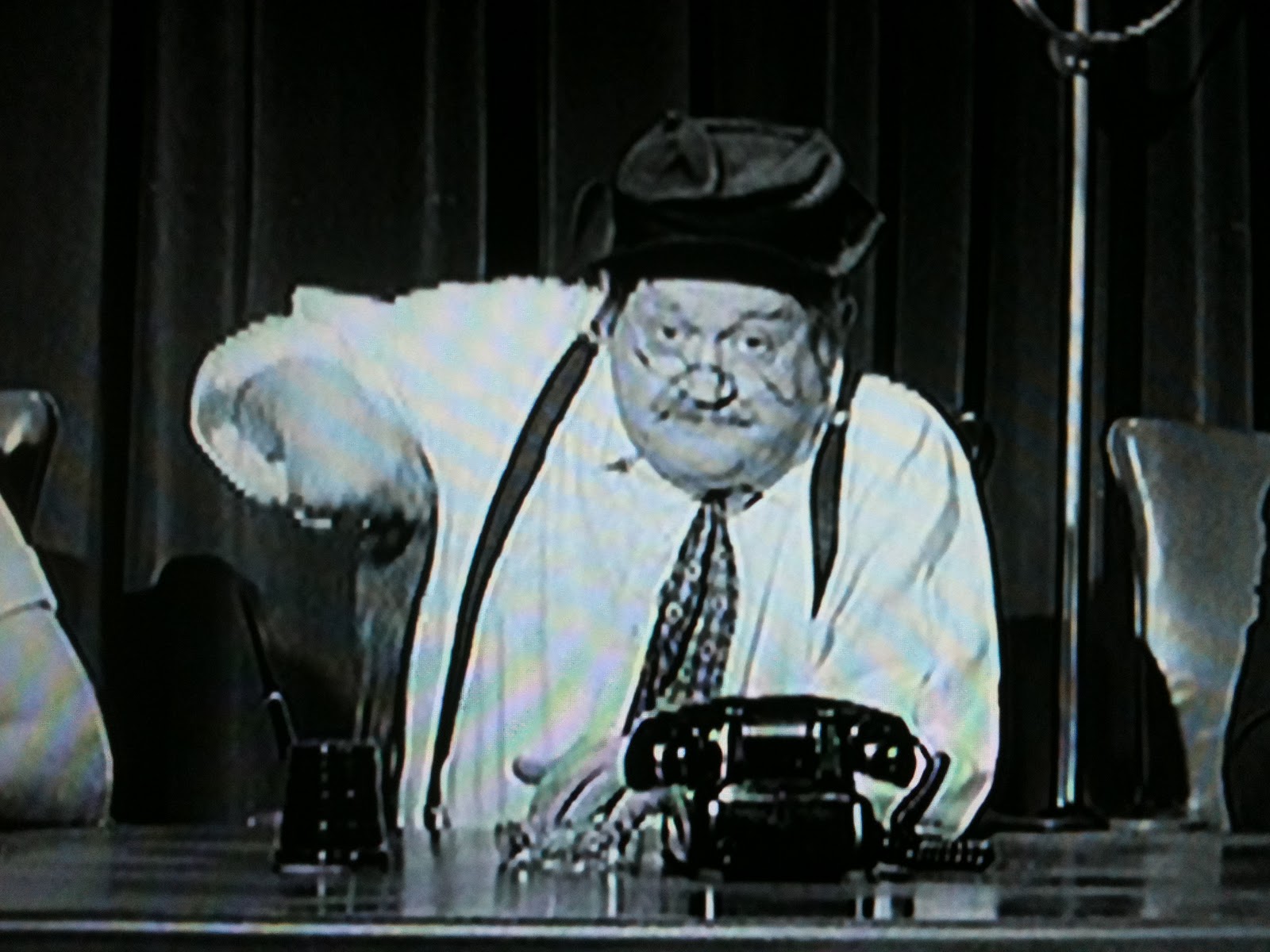
And, just to show you how persuasive Morey Amsterdam was back in the day, he even convinced The Greatest Actor Who Ever Lived to donate about a half hour of his time:

Mack Tuck!
Everything including the kitchen sink is thrown in, but to no avail: DON'T WORRY, WE'LL THINK OF A TITLE was barely a blip at the box office in 1966 and would be Amsterdam's only feature production credit and only screenplay.  He, Marie and Deacon went back to television, where they all remained welcome guest stars and game show panelists, with regular gigs on MATCH GAME, HOLLYWOOD SQUARES and THE MOTHERS-IN-LAW respectively.

So.....why isn't this on DVD yet?

It more or less vanished after barely being released in 1966, and never even received a VHS release. Until well into the 2000's few had even heard of it.  But TCM dusted it off a years ago, Netflix Instant added it in 2010 and now----MGM Archives has it available for pre-order.  So....on October 11th, according to this link--it will be!


Why it should be on DVD:


It might not be a good movie, but it is a genuine artifact of its television era, and it does give three beloved character actors a moment in the spotlight.  I'd say it's a must for DICK VAN DYKE SHOW fans to see at least once and any fan of 1960's television will probably find it worth a look as well.

As mentioned above, DON'T WORRY, WE'LL THINK OF A TITLE is available on Netflix Instant if you'd like to give it a look before shelling out the $19.95.

Saturday, September 24, 2011

Happy 25th, SLEDGE HAMMER! (Part 2 of 2)


SLEDGE HAMMER! - SEASON ONE (For PART ONE of our SLEDGE salute click here)


Episode by Episode mini-reviews of the 1986-87 season.  Key episodes in green


UNDER THE GUN (9/23/86)  ****-flawless introduction to Sledge, Dori and Trunk. 
The pilot sets the tone perfectly with Spencer really going for broke with his script and director Martha Coolidge nailing the numerous sight gags.  John Vernon is on hand to play the mayor who personally requests that Hammer be taken of suspension and given the assignment of locating his kidnapped daughter.  It's a shame Vernon never got to reprise the role; hes deadpan great.  The sorter version (eliminating the interrogation scene with recurring stoolie Don Stark as Kurt Krugle) actually flows better than the DVD version.  


HAMMER GETS NAILED (9/26/86) Guest star Ronnie Schell as a hard-nosed investigative reporter, who can make or break the department's budget when he requests to ride with the cops for a day.  Guess who gets the assignment?  Sledge's sensitive side emerges when he's confronted with a hungry criminal, and----nah, I can't keep a straight face and finish that thought. *** Some classic moments in this one, but Schell isn't one of the more memorable guests.

WITLESS (10/3/86) With a mafia contract out on his life, Hammer is ordered "far away from the city".     ***1/2 Arguably Spencer's funniest script, works brilliantly despite some of the more obvious network censorship.  Al Ruscio's Godfather shtick is put to very good use.

THEY SHOOT HAMMERS, DON'T THEY? (10/17/86) Guest star Jack Thibeau (ESCAPE FROM ALCATRAZ) is Hammer's old partner, who has broken out of prison and is spoiling for a showdown.  The first episode to explore Sledge's background and tell us a little about his father, the late Jack Hammer. ***1/2 Thibeau's outrageously over the top performance puts this episode in the winner's circle.  In addition to providing us with comedy gold, the psychotic character makes Hammer seem positively normal.


DORI DAY AFTERNOON (10/24/86)  Sledge and Dori are taken hostage in a bank holdup.  Attica!  Attica!  **1/2 Great opening gag, but pretty routine the rest of the way.

TO SLEDGE WITH LOVE (10/31/86)  Sledge tries his own version of "Scared Straight" with some juvenile delinquents. *1/2 The first real clunker, with long stretches in between solid laughs.

ALL SHOOK UP (11/7/86) A serial killer is targeting Elvis impersonators, so Hammer decides to put on his blue swede shoes and go undercover. **** Alan Spencer wrote this one in tribute to his late friend Andy Kaufman, and created one of the best-loved and well remembered episodes.  Deservedly so: inspired lunacy from start to finish.

OVER MY DEAD BODYGUARD (11/14/86) It's up to Sledge to protect mafia witness Captain Trunk, who has the added dilemna of a reconciliation with his ex-wife. ** Interesting to learn a little about the Captain's personal life, and guest star Tracy Reed (...ALL THE MARBLES) is always a welcome presence, but this is one of the less memorable episodes from a comedic standpoint.

MAGNUM FARCE (11/22/86) You knew it was only a matter of time before Hammer and friends gave us their take on the second Dirty Harry film, with David Leisure among the vigilantes. *** Fine spoof of the plot and politics of the original, right down to the identity of the vigilantes' leader.

IF I HAD A LITTLE HAMMER (11/29/86)  "I deal in scumsuckers, not thumbsuckers!"  Despite his protests, Dori gets the two of them assigned to a case involving babies being kidnapped for the black market. **1/2 Sledge + babies = more wonderfully outrageous un-PC humor.


TO LIVE AND DIE ON T.V. (12/13/86) Peter Marshall is a game show host who resorts to murder when a contestant gets uncomfortably close to a million dollar prize he can't pay off. **1/2 Very funny, but the forced change to a local, rather than network, show dilutes some of the intended edge.  Censorship ended up hurting this one.

MISS OF THE SPIDER WOMAN (12/20/86) Hammer has 11 hours to find the antidote after being poisoned. ** Your one chance to see Hammer and Doreau at a mud wrestling match.

THE OLD MAN AND THE SLEDGE (1/3/87)  Stephen Elliot plays Sledge's aging idol, who wishes to prove he can still cut it at age 72.  ***1/2 Surprisingly genuine heart combined with side-splittingly un-PC humor; one of the season's best.


STATE OF SLEDGE (1/10/87)  Sledge brings in the leader of a Satanic cult at the same time a by-the-book internal affairs officer reviews Hammer's file (brought in via wheelbarrow) **** Terrific script by Al Jean and Mike Reiss with some fine insight provided with the comedy.  One joke after another hits the bulls-eye, and interestingly, validity is given at various times to both Hammer's P.O.V. and the I.A. officer's as well.  The series had really hit its stride by this time.  This was the first episode to air without the laugh track ABC initially imposed.

HAVEN'T GUN WILL TRAVEL (1/17/87)  What happens when Sledge Hammer loses his prized gun?  **** Non-stop hilarity in this winner.  Kopell would return in Season Two for another great entry, LAST OF THE RED HOT VAMPIRES.


THE COLOR OF HAMMER (1/24/87) Sledge's favorite hanging judge turns up murdered.  ***1/2  Lots of expected slapstick and cliche-busting; I know, that's par for the course but some extra rapid-fire laughs here.  In a series known for great guest stars, an extra half-star for gorgeous Bond girl Martine Beswick's comic turn.

BROTHER CAN YOU SPARE A CRIME? (1/31/87)  Sledge's brother turns up out of nowhere, and proves to be the polar opposite of the Inspector, a ne'er-do-well with the ability to charm just about anyone.  **1/2  Decent enough, but not as sharp as it seems it should be.

DESPERATELY SEEKING DORI (2/7/87) Dori emerges from a concussion acting and dressing exactly like Hammer, hampering their efforts to crack a counterfeiting ring.  **1/2 Lots of the obvious here, which is amusing but doesn't reach the high gear of other episodes.


SLEDGEPOO (2/14/87) Scotland Yard and Kurt Kruggle help Sledge crack a cat burgling case.  **1/2 Sledge's new hairdo is the funniest thing here.  Rasche's knack for accents comes in handy yet again.

COMRADE HAMMER (2/21/87) Spencer and company had to get around to a Cold War episode sooner or later, and combine it with a trip to the Hitchcockian. *** Nicely done.  The series would return to Hitchcock land in Season Two with the arguably better "Vertical".

JAGGED SLEDGE (4/21/87) Hammer's on trial for murdering a mobster, and after firing his crooked attorney ends up defending himself--literally. *** Sledge in a courtroom was a frequent occurrence, and our favorite rogue generally delivered the goods there. The season's penultimate episode is no exception.

THE SPA WHO LOVED ME (4/28/87) . **** Lived up to the hype, and kept people talking about the show all summer back in '87.  But you could take away the climax and you'd still have one riotous episode.

Friday, September 23, 2011

Happy 25th, SLEDGE HAMMER! (Part 1 of 2)


SLEDGE HAMMER! (1986-1988 ABC-TV/New World Television) Starring David Rasche, Anne-Marie Martin, Harrison Page, Leslie Morris, Patti Tippo, Kurt Paul.  Created and Produced by Alan Spencer.

Twenty-five years ago today at 8:30 P.M. Eastern Time, viewers who stayed tuned to ABC after the season premiere of the thoroughly conventional WHO'S THE BOSS witnessed the debut of a truly different series that was very worthy of the overused phrase, "ahead of its time", SLEDGE HAMMER!

Starring David Rasche as the title character in what remains the best role of his career, SLEDGE HAMMER! gave us a hero who dealt with snipers (blowing up a building as the offender fired away from the rooftop) just as effectively as he handled purse snatchers (making the perp beat himself up at gunpoint).  He also found time to give to his favorite charity (Toy Guns for Tots) and to read classics like WAR AND PEACE (stopping after the first half).  Hammer occasionally revealed his sensitive side, but only to his most trusted confidante, his .44 Magnum named "Gun".  He talked to it, slept beside it, and even showered with it.

Ready for that Friday night meeting with Mr. Ewing, Captain!

Alan Spencer's creation was DIRTY HARRY by way of GET SMART!, and, at first glance, you saw a carbon copy of HUNTER's setup (pre-Roy Huggins, that is): square-jawed unconventional cop, beautiful but tough female partner, and apoplectic superior officer.  Anne-Marie Martin played Hammer's resourceful partner Dori Doreau, a martial arts expert ("I'd like to fight you sometime, Doreau") and Harrison Page (BEYOND THE VALLEY OF THE DOLLS) was Captain Trunk, who tried to harness Hammer and hypertension with equal futility.  After a while, Trunk's desk literally gained a prescription each episode, with the work area completely obscured by bottles and vials by the end of Season Two.


Over the course of these two wonderfully silly seasons Hammer and Doreau took on kidnappers, vigilante cops, crooked politicians, identity thieves, cat burglars, and even crooked game show hosts in riotous fashion every week.  Through it all, Sledge remained single-minded to a fault, but incorruptible and consistently quotable ("Trust me.  I know what I'm doing!").  He also revealed an impressive arsenal of hidden talents when going undercover: perfect Aussie and Cockney accents, self-representation in court, proficiency at billiards, and perhaps funniest of all, impersonating Elvis in "All Shook Up".

Those network schedulers are screwed in the head, I'm tellin' ya!


Like his (also hilarious) ABC cop brethren on POLICE SQUAD! before his day and THE JOB after, Inspector Hammer had a rough go of it in the Nielsens during his prime time run.  SLEDGE had the longest network run of the three despite the roughest scheduling.  For his first season, HAMMER! was literally caught in between Dallas and Miami, a "terrible place to be" (as he slyly noted in "All Shook Up").  CBS' DALLAS and NBC's MIAMI VICE converged at 9 PM ET on Friday nights for a head to head showdown, leaving little breathing room for SLEDGE HAMMER! opposite the top ten stalwarts.  It didn't help that the audience most likely to be hip to HAMMER was likely already out on the town on TGIF.


Ratings improved a bit in mid-season with a move to Saturday night, though the latter problem remained and the series was against another firmly entrenched hit (227) with no help from its ABC lead-in (SIDEKICKS).  Spencer also had to deal with weekly "input" from the network censors, which sometimes hampered the needed versimilitude--to name one example, a murdered informant in MAGNUM FARCE clearly doesn't have a scratch on him as he lays dying and supposedly bullet-riddled.  Despite his uphill battles with TPTB on scheduling and network standards, Spencer and his collaborators (most frequently Mert Rich and Brian Pollack) provided a series that was not only true to the creator's vision but often side-splittingly funny, with numerous episodes that remain well-remembered despite the terrible time slots (the show was up against THE COSBY SHOW after yet another time slot change) and a lack of wide syndication since the show ceased production.


While Spencer assembled a lot of talent behind the camera (Leonard B. Stern, Jackie Cooper, Bill Bixby, Tino Insana and Robert Wuhl among the other culprits) it was the actors who really shined while delivering their witty lines week after week.  David Rasche expertly walked a fine line, exaggerating his tough-guy squint just enough without ever becoming cartoonish or losing the hint of humanity (ever-so-slight, but yeah, it was there) under the tough exterior.  He was ably supported by Martin, beautiful but never mere eye candy, and Page, who took one of the oldest cop movie cliches in the book and found several new wrinkles for it.  His high-strung police captain stays in your memory more prominently than even Frank McRae's (48 HOURS) or John Amos' (in the aforementioned HUNTER)--no small feat.


Sadly, the 41st episode on 2/12/88, in which we finally meet the oft-referred to ex-Mrs. Hammer, (played by Heather Lupton, the real-life Mrs. Rasche) was the end of the line for the good Inspector.  But the series lived on, sometimes in unexpected ways. SLEDGE HAMMER! clearly influenced Zucker, Abrahams and Zucker when they fashioned their similarly neglected POLICE SQUAD! into the NAKED GUN feature film franchise.  Frank Drebin wasn't particularly trigger-happy when his adventures aired on ABC-TV, but acquired this characteristic in a big way but for his cinematic adventures, along with several other shadings that appeared to be Hammered into him after the series.  Vacationing in Beirut?  Sledge beat Drebin to it by two years ("Witless").  Drebin laughing his ass off at PLATOON?  Sledge's "favorite comedy" was THE DEER HUNTER.  Involving a student driver in a high speed chase?  Hammer had been there, done that one too ("Hammer Gets Nailed").

SLEDGE HAMMER! has yet to see its own sequel on the big or small screen, so loyal Hammerheads have had to make do with the "original 41" ever since, but the lack of a filmed reprise hasn't made the show's afterlife any less interesting or impressive.


New World released 4 episodes on VHS in 1991, and the solid sales resulted in plans to release the complete series on 10 two hour tapes.  Unfortunately New World's financial difficulties resulted in the TV division being sold to Sony before the release came to fruition, and frustrated Hammerheads had to make do with bootlegs and memories for the next decade.  But Alan Spencer (whose subsequent credits include THE NUTT HOUSE in collaboration with Mel Brooks and the feature HEXED) never stopped championing his classic creation or looking for a suitable distributor.  Spencer's official website launched in 2002 and was quickly host to over one million unique visits while the out of print VHS tapes went for consistently high sums on ebay into the new millennium. 


Finally, in 2004 Anchor Bay stepped forward to release SLEDGE HAMMER! SEASON ONE on DVD with extras including commentaries, a documentary with interviews of the principal cast, original advertisements and inserts.  Perhaps best of all, the laugh track ABC insisted on for the first 13 episodes was removed entirely.   Brisk sales for the set ensured that Season Two followed in 2005.  Loyal Hammerheads also inspired the first, but probably not last, Sledge Fest just last October.  It was a sold-out success.  Well marketed too:  

And how many SledgeFest tickets for you, Sir?

Sledge was prematurely cancelled, but these recent events prove that his show will never die. So happy birthday Sledge, and let us continue celebrating your ground-breaking humor and your Silver Anniversary all weekend.  Coming up next, Part Two:  will follow later this weekend, with an episode guide to the initial season.  Meanwhile, as Sledge himself once said, obey the penal codes.


"Every breath you take, every move you make... I'll be watching you. That's police talk."  -- Inspector Sledge Hammer